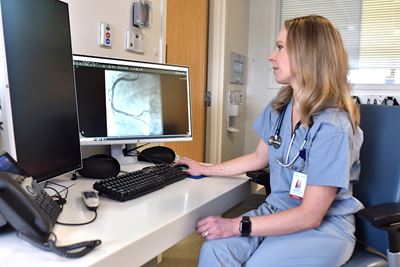
The Westerly Hospital Vascular Program, part of Yale New Haven Health’s Heart and Vascular Center, offers a multispecialty program for managing patients with non-healing lower extremity wounds, including patients with critical limb ischemia, peripheral arterial disease, diabetic foot and ankle complications and other cardiovascular disease.
The program includes a team-based approach with Westerly Hospital medical staff providing coordinated patient care that delivers better outcomes.
Our team includes specialists in vascular medicine, interventional cardiology and certified wound experts. Our combined expertise enables high-risk patients to be diagnosed early, which facilitates timely treatment.
Critical ischemic limb disease occurs when an artery in the legs is partially or completely blocked by atherosclerotic plaque, limiting blood flow and reducing the amount of oxygen supplied to the extremities. This is the most severe form of peripheral arterial disease and patients with critical limb ischemia are at risk for tissue necrosis and limb loss. Patients with advanced leg ischemia often suffer from pain in their feet and toes, even while at rest, and may suffer from non-healing wounds, skin ulcers, and poor foot/ankle surgical wound healing. Active patients may also suffer pain during exercise.
When patients enter our Vascular Program, they receive priority access to multispecialty care in one convenient location. Patients are able to undergo immediate non-invasive testing such as ankle-brachial index and lower extremity ultrasound studies at the time of or before their visit.
All patients are evaluated by a vascular provider during the same initial visit. From cases affecting only one limb, to more complex situations involving patients with heart disease or stroke, our experts consider “the whole patient” as a coordinated team.
As part of Yale New Haven Health, we are able to provide access to cutting-edge clinical trials for lower extremity revascularization and novel therapies for advanced wound care. Interventions for lower extremity peripheral arterial disease include complex endovascular procedures (angioplasty, stenting and atherectomy) and bypass surgery. The program's multidisciplinary nature allows our providers to select the best treatment options.

As someone who works in Marketing and Communications for Yale New Haven Health, I often write copy aimed at promoting the vast array of healthcare services this organization provides. None of that was on my mind, however, the day I became a patient – the day I sat in the office of a cardiac surgeon at Yale New Haven Hospital discussing whether I will need open-heart surgery to fix an ascending aortic aneurysm.
Read MoreYale New Haven Health is proud to be affiliated with the prestigious Yale University and its highly ranked Yale School of Medicine.